A reproducible starting point.
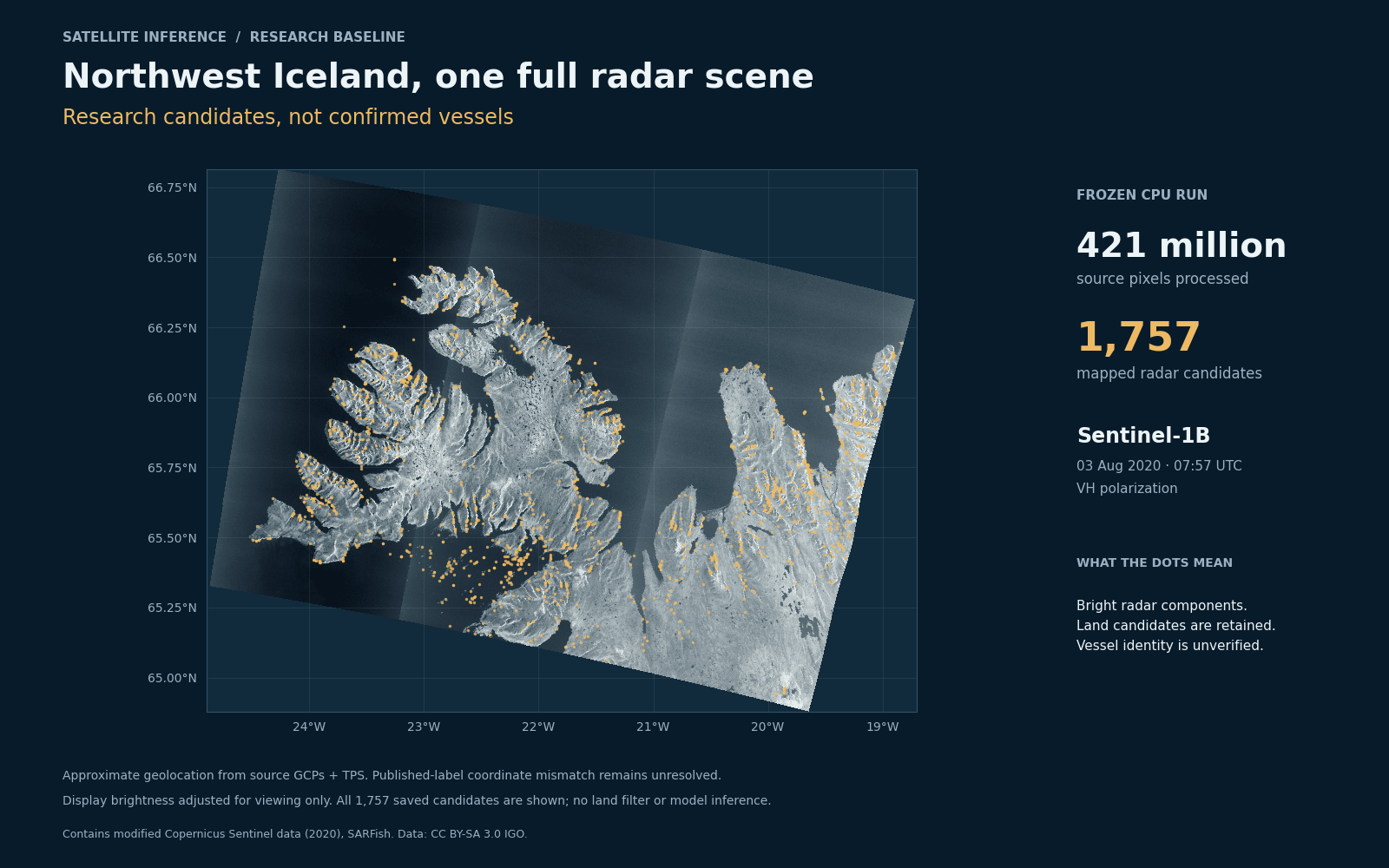
Historical radar-scene processing and bounded CPU/GPU model-execution experiments provide a starting point for representative customer tests.
 Satellite InferenceAI Inference in OrbitGet in touch
 RESEARCH REVIEW / 4 OCTOBER 2026
The current program builds on ground experiments in data processing and model execution. Its next milestones are a customer-defined evaluation, host access for Orbit-0 and tested SI-P1 hardware.
01 / THE EXISTING RECORD
Historical radar-scene processing and bounded CPU/GPU model-execution experiments provide a starting point for representative customer tests.
An approved software experiment on an orbital GPU is planned, subject to provider access, workload compatibility and operator approval.
The hardware program targets a hosted Thor-class payload with an Orin fallback, environmental test evidence and a host-defined interface.
These results provide starting evidence for a customer pilot. They do not establish a production runtime or flight qualification. The dated technical record preserves configurations, timings, quality limitations and source provenance.
02 / THE NEXT EXPERIMENTS
| Question | Planned test | Evidence required |
|---|---|---|
| Can a customer trust the model? | One approved model on held-out, representative data, with data rights and acceptance criteria agreed in advance. | Task quality, failure cases and performance against the customer’s baseline. |
| Does the operator stay in control? | Approval, scheduling, resource limits, suspension, signed updates and recovery on a host emulator or representative compute. | Reproducible test records showing enforced limits and operator authority. |
| Can software be reused? | Keep the workload and runtime contract fixed while validating the adapter for each selected platform. | Integration effort, consistent results and measured platform-specific limits. |
| Is there a commercial benefit? | Compare quality, useful delivery time and full deployment cost with the strongest feasible ground workflow. | A customer acceptance decision and a priced deployment scope. |
Power, thermal conditions and radiation behavior require tests appropriate to the selected hardware and mission. Ground software fault injection helps test recovery, but does not measure radiation susceptibility.